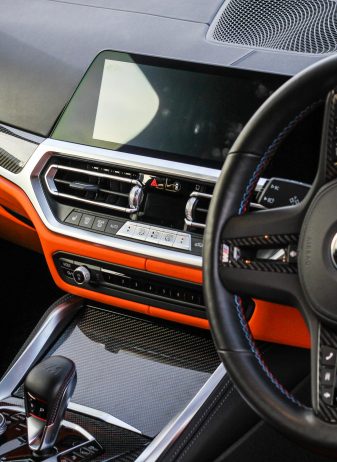

Drivers choose European vehicles for a reason. A BMW through a sweeping corner, an Audi on the autobahn, a Porsche launched from a stoplight — these cars are built to deliver a specific feeling. Precise, responsive, alive. When that feeling starts to fade, something is wrong.
Performance loss rarely announces itself dramatically. No sudden breakdown, no obvious failure. It creeps in — a little hesitation off the throttle, slightly softer acceleration, an idle that doesn’t quite feel right. By the time most drivers notice, the underlying issue has often been developing for months.
The good news: most causes are identifiable and correctable, especially when caught early. Here’s what commonly robs European vehicles of their performance, and why each one deserves prompt attention.
Restricted Airflow: The Air Filter Problem
Your engine burns a precisely calibrated mixture of air and fuel. Restrict the air side of that equation and power drops — it’s that direct.
A clogged air filter does exactly that. Contaminants accumulate over time until airflow is measurably reduced, and European performance engines are particularly sensitive to it. Symptoms include sluggish acceleration, poor throttle response, and declining fuel economy. It’s one of the simpler maintenance items on the list, but its impact on how the car feels is real.
Carbon Buildup in Direct Injection Engines
Direct injection technology — found in most modern BMWs, Audis, Mercedes-Benz, and Volkswagens — delivers fuel efficiency and performance gains that older systems can’t match. But it comes with a known tradeoff.
In traditional systems, fuel washes over the intake valves, keeping them clean. Direct injection bypasses that process entirely, allowing carbon deposits to accumulate on the valves over time. The result: restricted airflow, rough idling, hesitation under acceleration, reduced power, and occasional misfires. This issue is common enough in European vehicles that it warrants periodic inspection even when symptoms are subtle.
Worn Spark Plugs and Ignition Components
Every combustion event in your engine starts with a spark. As spark plugs wear, that spark becomes less reliable — and European engines, with their tight tolerances and sophisticated engine management systems, amplify the consequences.
A single degraded spark plug can produce rough running, misfires, sluggish acceleration, and increased fuel consumption. Ignition coil failures produce similar symptoms. These components have service intervals for a reason, and ignoring them gradually chips away at the performance the car was built to deliver.
Turbocharger Issues
Turbocharged engines dominate the modern European lineup — and for good reason. They extract more power from smaller displacement engines while keeping fuel consumption in check. But a turbocharger that’s beginning to fail makes its presence felt immediately.
Watch for a sudden drop in power, unusual whining noises under boost, excessive exhaust smoke, or rising oil consumption. Turbocharger problems rarely resolve themselves, and early diagnosis keeps a manageable repair from becoming a major one.
Fuel System Degradation
A healthy fuel system delivers the right amount of fuel at the right pressure across every driving condition. When injectors clog, fuel pumps weaken, or filters restrict flow, that delivery becomes inconsistent.
The symptoms — hesitation during acceleration, rough idling, difficulty starting, reduced power — can mimic several other issues, which is why accurate diagnostics matter here. European fuel delivery systems are sophisticated enough that guesswork wastes time and money.
Sensor and Electronic Faults
European vehicles use dense networks of sensors to continuously monitor and adjust engine operation. Mass airflow sensors, oxygen sensors, throttle position sensors, boost pressure sensors — each one feeds data to the engine management system that directly influences how the car performs.
When a sensor provides inaccurate readings, the system compensates incorrectly, and performance suffers even if the mechanical components are in good condition. Making this more difficult: a failing sensor doesn’t always trigger a warning light, at least not immediately. Professional diagnostics can surface these faults before they become more disruptive.
Transmission Problems That Feel Like Engine Problems
A loss of performance doesn’t always originate in the engine. European dual-clutch and automatic transmissions are among the most sophisticated in the industry — and when they develop issues, the car can feel dramatically less capable.
Delayed shifting, harsh gear changes, slipping, and unexplained hesitation during acceleration can all trace back to transmission wear or deferred service. Transmission maintenance intervals are easy to overlook, but neglecting them is one of the more common ways European vehicle performance quietly degrades.
Suspension, Alignment, and Handling Loss
Performance isn’t measured purely in horsepower. The handling precision, cornering confidence, and road feel that define European vehicles depend on suspension components and alignment being in proper condition.
Worn bushings, degraded dampers, and incorrect wheel alignment all dull that feeling — the car wanders, corners less confidently, and gives imprecise feedback through the steering. These changes come on gradually, which makes them easy to rationalize as normal aging. They’re not.
Sticking Brakes
A brake caliper that fails to release properly creates constant mechanical resistance the drivetrain has to fight. The result is reduced acceleration, a burning smell near a wheel, uneven brake wear, and the vehicle pulling to one side.
Drivers rarely connect these symptoms to the braking system, which is why it often goes undiagnosed longer than it should.
Incorrect or Degraded Fluids
European manufacturers specify fluids for a reason — engine oil viscosity, transmission fluid formulation, and coolant chemistry. Using the wrong specification, or leaving the right one in too long, affects engine operation, transmission behavior, cooling efficiency, and in some cases, steering feel.
It’s a detail that’s easy to get wrong when service isn’t performed by someone familiar with manufacturer requirements.
What Deferred Maintenance Actually Costs
Most performance concerns have something in common: they develop quietly when routine maintenance gets delayed. Oil changes, filter replacements, fluid services, spark plug inspection, brake checks, diagnostic scans — individually, these seem minor. Collectively, they’re what keep a European vehicle performing the way it was engineered to.
Skipping them doesn’t save money. It relocates the cost to a later, larger repair.
Why European Vehicles Need Specialized Service
General repair experience doesn’t always translate to European vehicles. The engineering is different, the electronics are more complex, and the diagnostic equipment required to read these systems accurately isn’t universal.
A technician familiar with BMW engine management software, Audi MMI diagnostics, or Porsche’s PDK transmission calibration is working from a fundamentally different base of knowledge than one who isn’t. That difference determines whether the root cause gets found — or whether a symptom gets treated while the actual problem continues.
If your European vehicle doesn’t feel the way it used to, that change is worth investigating. Performance loss is information — and the earlier it’s acted on, the less it costs to correct.
At European Automotive, our team specializes in servicing, diagnosing, and repairing luxury and performance European vehicles. With advanced diagnostic equipment and hands-on experience across BMW, Mercedes-Benz, Audi, Porsche, Volkswagen, Alfa Romeo, and more, we find the source of the problem — not just the symptoms. Contact us to schedule an inspection and get your vehicle driving the way it should.